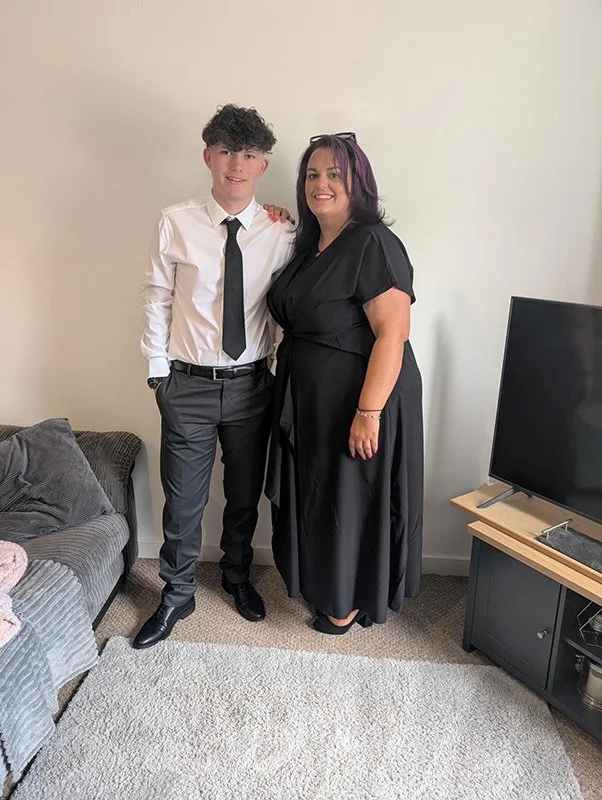
Helen with her 15-year-old son.
Her greatest motivation.
“My cane gives me my freedom, and it gives me the independence that I should be able to have at nearly forty years old, but it also makes you more visible and opens you up to discrimination.”
Helen works for a brilliant regional charity called Vision Support as their Financial Wellbeing & Benefits Officer, and when we speak, she is sitting in her shared offices in Chester on a sunny afternoon. It would be easy to assume that there is nothing all that remarkable about this fact, but as she shares her story it becomes apparent just what an incredible achievement this is, and how hard the road to get to where she is today has been.
In 2017 Helen was living what to many might have looked like a fairytale life, having moved abroad to live on a military base in Cyprus with her new husband, as well as her young son. Life looked so promising, but the reality soon became very different, with the shadow of domestic abuse clouding her days. “I was madly in love, and I didn't want to ruin my family home, as my son was already from a broken home” she explains, and so she stayed, determined to make the best of it. One day, she was in front of the mirror and realised that she couldn’t see clearly out of her right eye. Having never had any issues with her vision before she was naturally concerned and decided to visit the optician’s back at home in the UK.
The optician referred Helen to the hospital’s eye clinic for further tests. There, the consultant told her, “We don’t know what it is, but there’s a mass behind your eye. We don’t know why. It might be macular degeneration, although this is very rare in someone of your age.” With no clear diagnosis, Helen returned to Cyprus, still in the dark. Her migraines worsened, and eventually the military agreed to fund private care. She was quickly referred to a specialist who suspected she had ocular melanoma. “I was shocked. How had it changed from being possible macular degeneration to this?”
“I immediately packed my bags and was put on a medevac flight home, which was really, really stressful. I was examined by a professor in Liverpool, and I had scans and all sorts of tests. The professor went through the results, he said ‘you haven't got melanoma; that's the good thing. However, you've got significant scar tissue on the back of your eye because you've had a bleed on the brain, it's leaked in behind the eye and burst.’ I'd had a macular haemorrhage, and this was why I'd lost the sight in my right eye. He asked me if I’d had any ‘bangs to the head’ and I said no. But I knew exactly how I'd lost my sight. I knew what had happened, and I knew when it had happened.”
It was a realisation Helen has never forgotten — understanding that the violence she had endured had taken something from her that she could never get back. Losing her sight was more than a physical injury; it became a reminder of how deep the impact of abuse can go, and how those moments can stay with a person long after they are over.
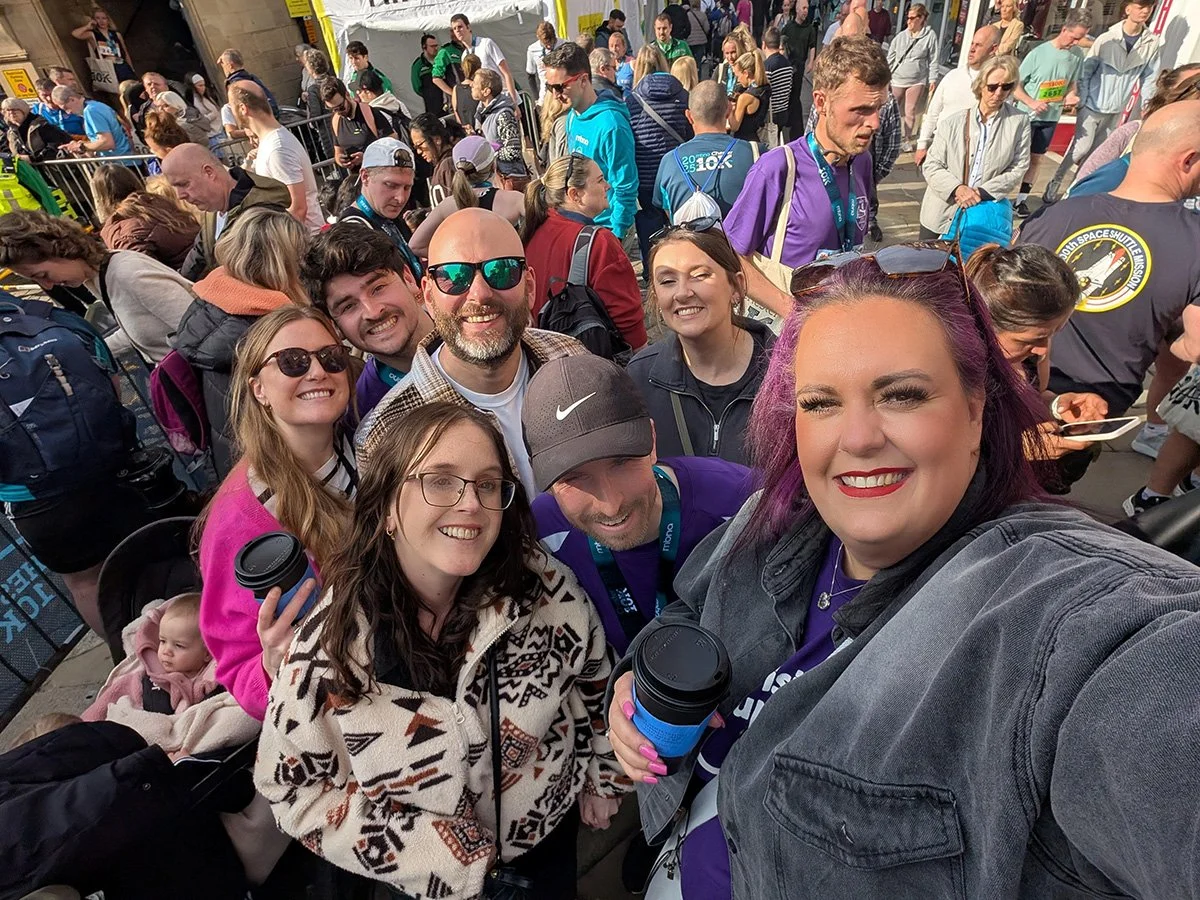
Helen with her boyfriend, colleagues, and their partners at the Chester 10K. They were cheering on Matt and his guide runner, Lewis.
Back in Cyprus and reunited with her son, she now understood the cause of her vision loss, but had received no guidance on what to expect, or how to adapt to this life-changing diagnosis. In 2018 with her eyesight still deteriorating, Helen and her son finally moved back to the UK to start rebuilding their lives, initially moving in with her brother as she began to adjust to her new reality. The first year back in the UK was one of both highs and lows. “We received some help from the Armed Forces charity (SSAFA) to move into our own home, it was great, but for all that was positive in my life I had my sight loss looming over me. I knew my whole world was changing around me, and yet I knew nothing about how to live with it. I knew nothing about sight loss or about the pathways to find support. There seemed to be nothing out there to help.” Over the course of that year Helen had multiple appointments but her sight continued to deteriorate until she had lost all vision. This was a lot for her to deal with, and during this time she often felt lost, scared and alone, with no idea how to navigate through such a difficult diagnosis. During her next appointment once again, no help was offered.
“The hospital confirmed that yes, you've lost your sight, but there’s nothing we can do so we will see you in six months’ time. Nothing more. No support. No referrals. Nothing. I remember coming out of there and I was absolutely sobbing my heart out because it was all too much. I’d left my marriage and moved back to this country. I'd left everything I'd known behind and now I'm losing my sight. I had an 11-year-old boy who needed me. With no job I just kept thinking what am I going to do? How will we manage?”
But even in those darkest days, Helen wasn’t completely alone. Her sister and close friends became her lifeline. “They didn’t know anything about sight loss either, but they stood by me through it all. They listened when I cried, they helped me when I couldn’t see a way forward, and they never once judged me. They learned alongside me, and they loved me through it. I’ll be forever grateful to them for walking that journey with me.” Their support gave her the courage to keep going — a reminder that even when life takes so much away, love and friendship can help rebuild what’s been broken.
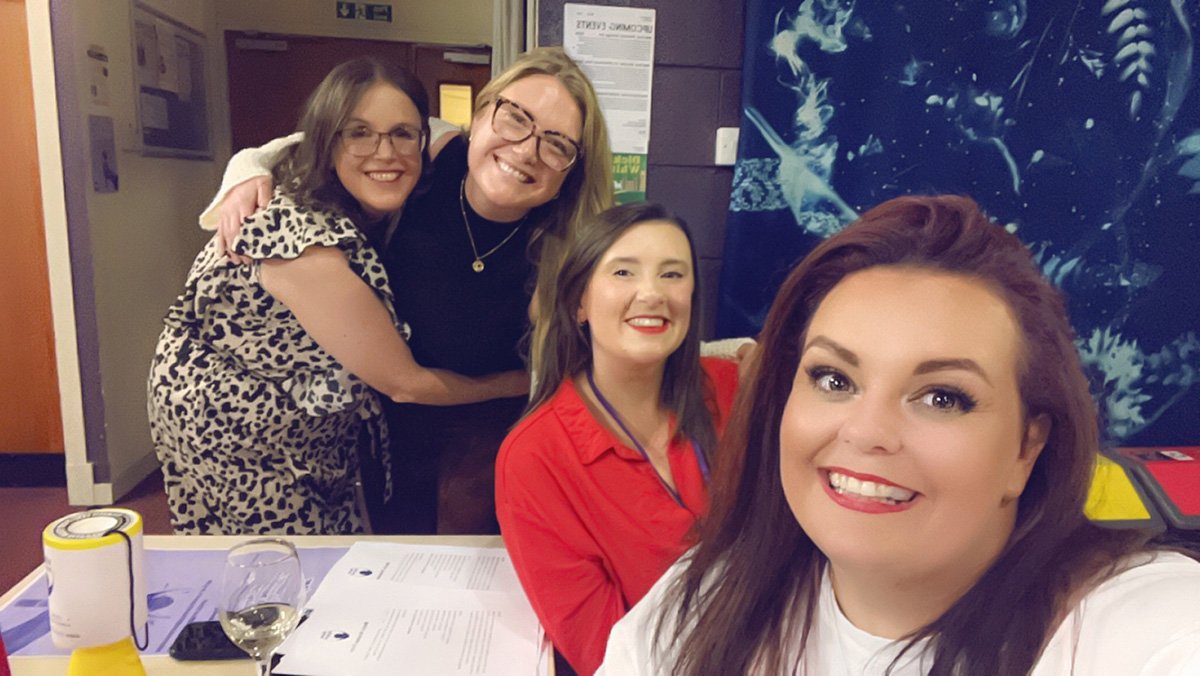
From left to right: Helen’s wonderful colleagues Nia, Kate, Jess and Helen herself. At the very first Vission Support Open Mic Night in North Wales.
As she left her appointment, visibly distressed, she bumped straight into someone and that proved to be the turning point for her. “The man I bumped into was called John, he was an Eye Care Liaison Officer, or ECLO. They provide information, emotional support and advice if you have a condition which affects your sight, and after he stopped me to ask if I was OK, I just blurted out that ‘they've just told me that there's nothing that they can do, and I don't know what to do.’ He invited me into his office, and he put me in touch with lots of different people, including Vision Support, the charity I now work for.”
With John’s support, Helen discovered what should have happened when she was told that she had permanently lost her sight, and what steps were still needed. She should have been supported to register her sight loss with her local council, who are then able to issue a Certificate of Visual Impairment (CVI). This in turn should trigger an automatic referral to the local authority to provide advice, support and training. “What should happen then is that the local authority should get in touch with you, and they should offer you independent living or cane training, or anything else like that you might need.”
Helen slowly began to rebuild her life, she found part-time work and began to regain her independence, feeling much more hopeful about the future than she had done in a while. Unfortunately, she soon lost her job due to them being unable to accommodate reasonable adjustments for her. Around the same time, she caught pneumonia, her mental health suffered, and she slipped into depression.
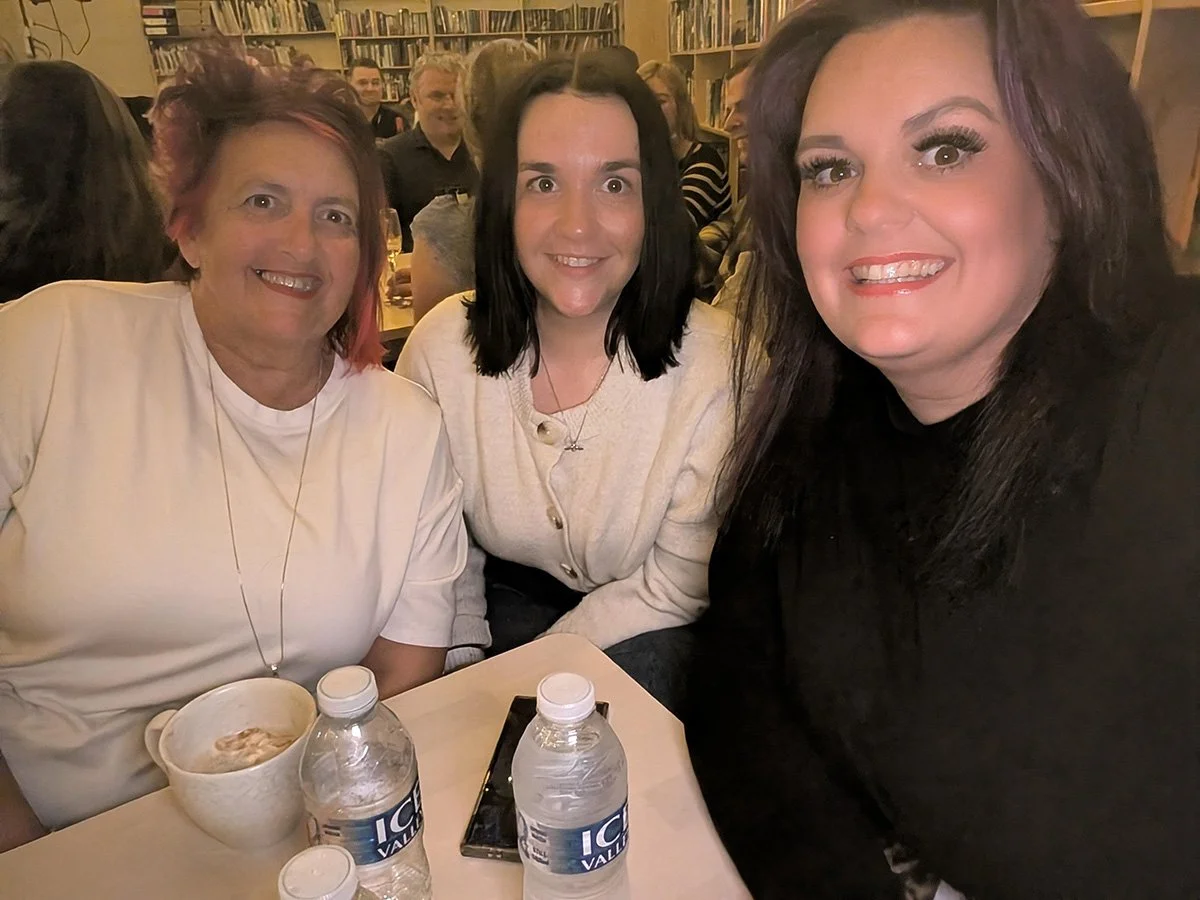
Helen with her sister, Deby and her niece, Charlotte. Two of the most important people in Helen’s life.
It was during these difficult days that Helen met Nia, who works for Vision Support. The charity offered her some digital skills training which proved invaluable, as it helped to unlock the world for her once again. The emotional support that she offered proved to be as important as the training. “When Nia reached out to me everything changed. Often, she was just that positive voice that I needed, and to know that there was someone who cared. She's also had sight loss, she understood what I was going through.”
Another key turning point for her came when Nia asked her if she might consider being a case study for the Wales Council of the Blind as part of a presentation at the annual Wales Eyecare Conference. Being given the opportunity to share her story, and how the lack of timely access to a VRS (a vision rehabilitation specialist) had negatively impacted her was a powerful experience, and she recalls how “at this point, although I felt so low in how I felt about myself and my situation, I knew that I wanted to be able to make the sight loss pathway better for everybody.”
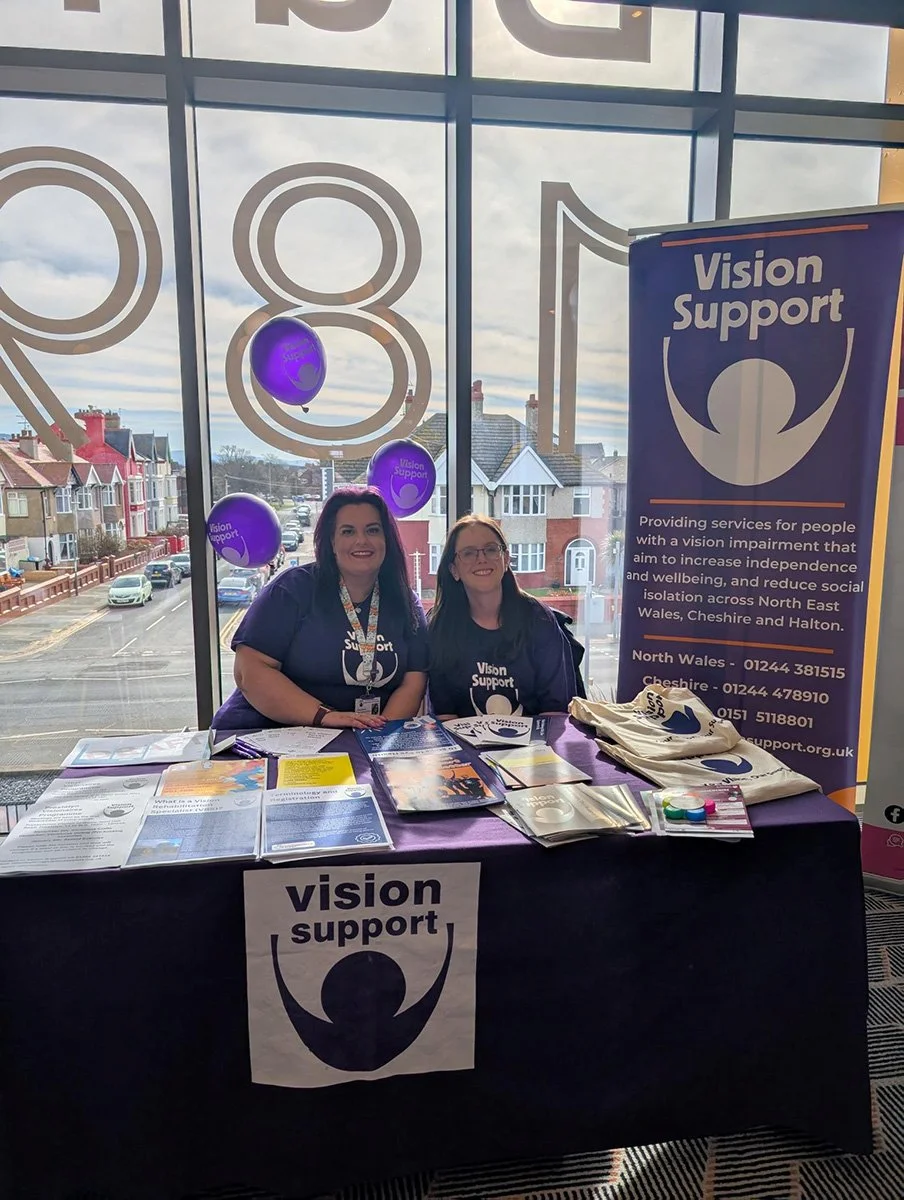
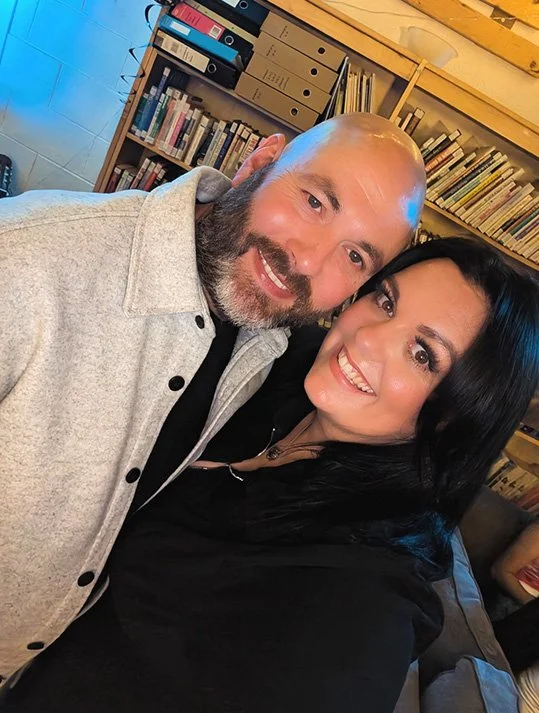
“I spoke about how losing my sight overnight really felt, what I could do before, what I can and can't do now, and how everything changed so suddenly for me and my whole family. I spoke about how it had affected me, affected my friends, my family and especially my son. Overnight he became my carer, and I didn't want that for him. I just wanted him to be my son, I'm the one who should protect him. I was only thirty-four, and I should be living my own life, not relying on him to hold mine together. It was great, I loved it speaking and sharing my story, and I knew then that this was something I'd really like to do.”
But standing there, nervous yet determined, sharing her story, Helen realised something important. Despite the fear and uncertainty, she loved it. In that moment she knew that this was what she wanted to do — to support others living with sight loss. To make sure they received the right information, the right guidance, and to reassure them that they were never alone.
Over the coming years, and through the friendship and support offered to her, Helen was able to not only regain her independence and rebuild her life, she seized every opportunity with both hands, determined to make the most out of it. Her sister Deby, her son, her closest friends and later her colleagues, became a constant source of strength. They understood her from the very beginning, without judgement, and they stood beside her through every difficult chapter. Her partner, gentle and patient, offered her the kind of stability and kindness she had not always known — a reminder that love does not have to hurt, and that she deserved safety, warmth and respect.
Today she is employed as a Financial Wellbeing & Benefits Officer for Vision Support, her son is fifteen years old and thriving, and she is surrounded by people who truly see her, not just her sight loss. Having finally received her cane training, she is able to once again safely navigate the world on her own terms, without needing someone by her side. Her sight loss however continues to progress, and she has now been certified as ‘severely sight impaired’ (blind). The specialists believe that she had a stroke behind her left eye, although they are still not clear why. They do know that what functional vision she still has left will also eventually be lost.
Helen reflects “I think I've reached a place of acceptance now. Of course, it is sad to think that one day I won’t be able to see my son anymore, but I can’t live in fear. Instead, we make the best memories, we laugh, and we keep going, I always try and take a positive from what happened to me. I can see how much I’ve grown, how much strength I’ve found, and how far I've come in reclaiming my independence. Right now, my life is the happiest it has ever been, and I’m the strongest I've ever been - with or without sight.”
For anyone reading this that is struggling with sight loss themselves, or knows someone who is, Helen hopes that they know this: “you are not on your own. Please reach out to a charity like Vision Support — there is help, there is guidance, and there are people who truly understand”.

FIND OUT MORE
About Rarity Life:
Rarity Life is an online publication that offers those affected by rare disease, disability and cancer the opportunity to create content that is truly inclusive, to unify our collective experience and to celebrate and share our differences.
To read the latest edition and all previous releases of Rarity Life click here.
About Acquired Blindness:
When we refer to ‘Acquired blindness’ it describes a loss in vision that has occurred after birth, and as such is different from congenital blindness, which is present at birth. There can be a number of reasons why someone might end up with acquired blindness, including trauma, environmental influences or diseases and/or degenerative conditions.
A loss of or reduction in our vision can occur naturally as we age, this again differs from acquired blindness. The definition of which specifies a ‘significant loss of vision that occurs due to factors encountered after birth’, and the severity of the vision loss experienced can range from a partial impairment to complete blindness.
To find out more visit the Battle For Blindness website here.
Vision Support:
Vision Support are proud to provide vital services across North Wales and Cheshire for people living with vision impairments. Every day, we work to help people feel confident, connected, and capable—because living with a vision impairment should never mean facing it alone.
They’ve been part of the community for nearly 150 years, and throughout that time, they’ve supported countless individuals and families as they adjust to sight loss. From those first moments of uncertainty to rediscovering independence, Vision Support are there—offering practical help, emotional support, and opportunities to connect with others who understand.
Every penny Vision Support receive through donations truly makes a difference. Your support helps fund counselling, digital skills sessions, welfare rights advice, rehabilitation, home visiting services, and a wide range of social activities that bring people together. These services help people regain confidence, rebuild their lives, and find joy in new experiences.
Beyond the day-to-day support, Vision Support are also passionate about raising awareness of vision impairment. They want to build a more inclusive and understanding society, where people with vision impairments are empowered to live full and independent lives.
As Vision Support look ahead to their 150th anniversary in 2026, they are preparing a busy schedule of events and celebrations that reflect their long history and the communities they serve. It’s a milestone they’re proud to share with everyone who’s been part of the journey.
Together, we can continue to make a lasting difference for people with vision impairments.
To find out more about the work that Vision Support does click here.