
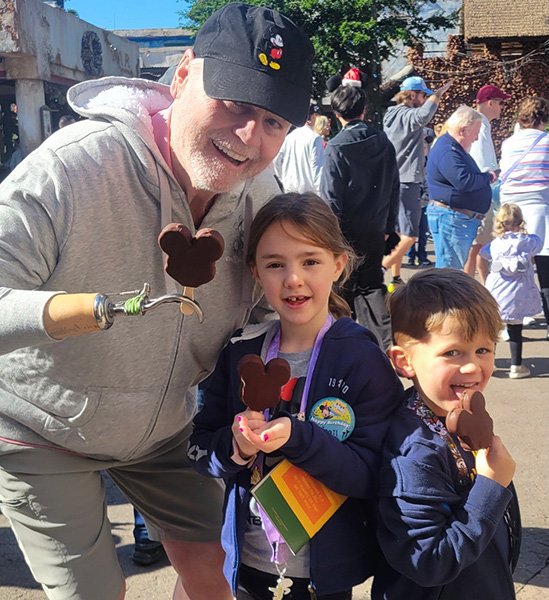
John with his daughter, Whitney. Photograph courtesy of John W Lawson
“One day, about two years after I lost my hands, a friend from a dinner theatre where I had performed before called me up and said ‘Hey, they amputated your hands, not your voice. Come sing, I could use you on stage. So I did.”
John W Lawson is an American actor, singer, TV and film panellist, TED talker and disability and inclusion advocate, whose recent film, DARUMA, has been receiving critical acclaim globally. His mother, a classical violinist who had played professionally in orchestras, sat him in front of a piano at the age of just three years old, by four he had begun lessons.
“I studied piano continuously, classical piano, from the age of four all the way through to college. At college I was a piano and drama major, and I also took voice lessons there, because I was born with this big, operatic voice. I've always been in the theatre, doing high school plays, then community theatre and all of that, so it was always part of my life. After college I played piano professionally for years, classical piano with orchestras across the United States, as well as singing opera professionally, and some acting and theatre work too. I was in New York doing an Off Broadway show, and an audition came up for a TV show and I got it. At the time I thought ‘I like this TV thing, it’s a lot of fun,’ so I started kind of pursuing acting more.”
Like so many people in creative fields, John often had to pick up ad-hoc work between projects. In early 1987, whilst waiting to relocate with his young family to Florida, where he was due to begin an exciting opportunity singing with the world-famous Voices of Liberty cappella group at EPCOT in Walt Disney’s World, he found himself painting water towers in North Carolina. “I’d picked up some overtime, and when I arrived at the site to help finish painting a tower I saw that the foreman already working on the suspended platform, he signalled for me to climb up, so I geared up, tied off, and joined him as he painted the legs of the water tower. He had a 17‑foot telescopic extension pole with a small roller, I noticed we’d missed spot, so I grabbed the roller from the handrail to use it, once done I set the long pole along the to rest for a moment. But as I went to pick it back up the end of the pole came close to a high‑voltage electricity line, 7000 volts of electricity surged into the pole and travelled through me, entering under my arm and exiting where my left buttock was touching the handrail.”

Photograph courtesy of John W Lawson
John suffered extensive burns and internal injuries, and was rushed to the nearest hospital, before being transferred to a specialist burns centre, where he spent the next six months. After waking from a medically induced coma he spent the following months undergoing countless surgeries, followed by occupational and physical therapy. By the time he was discharged both of his hands had been amputated, his marriage had fallen apart and life looked very, very different. “I came out of the hospital with no hands, no house and no wife, and it turned out to be the best rehab I could have had. I rented a house and learned to take care of myself. I mean, if I couldn't do it, then it didn't get done. It really forced me to use the skills I'd learned in physical therapy and occupational therapy, but I also had to learn how to do things on my own. It was tough, but I did it.”
Losing both hands would be devastating for anyone, but for a musician whose hands were so central to the instrument they played it was a particularly cruel blow. John had never lived in a home without a piano in it, and playing it brought him both joy and comfort, as well as forming an integral part of his career. “Playing the piano was sort of like my psychologist, and even as a teenager I would sit down and just start playing. I’d play for up to two hours, never taking my fingers off the keyboard. My mom would know, depending on what I was playing, if something was bothering me, so she would come check in on me, and we’d talk. As an adult, it was the same way.” John continues, “One day, about two years after I lost my hands, a friend from a dinner theatre where I had performed before called me up and said ‘Hey, they amputated your hands, not your voice. Come sing, I could use you on stage. So I did.”
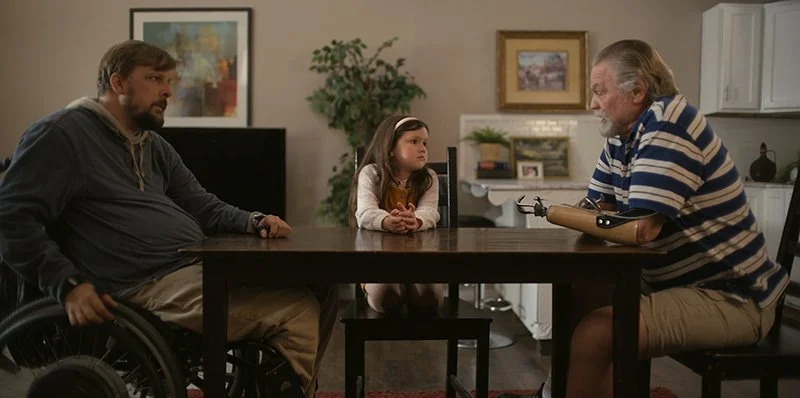
John Lawson, Tobias Forrest, & Victora Scott in DARUMA. Photograph courtesy of KLA Media
This decision proved to be life-changing, and not only because it got John back on stage where he belonged, but because the pianist playing in the pit orchestra would eventually become his wife, and, he recalls softly, the true love of his life. “I didn't think a woman would want to have anything to do with me, because I felt like I was half a man, I guess. But when I met Debbie I did what came naturally, and started flirting, and next thing I know, we're going on a date. We dated for two years, and then we got married.” John and Debbie each brought a child into the marriage and went on to have a daughter together too. When their daughter was just two years old Debbie was diagnosed with terminal breast cancer, and when she passed seven years later John’s world was once again completely upended. “Suddenly I was a single parent to three kids, so it wasn’t until they had all grown up that I moved to California to try to pursue acting again. Until then I had put everything on hold because of all the other things that happened in my life; my accident, losing my wife, raising the kids.”

John with his daughter Whitney. Photograph courtesy of John W Lawson
John had been in the industry long enough to know that it might not be easy, but, as he explains, he’d thought that there would be a place for him. “I remembered how after I got hurt, I thought there'd be all kinds of roles for guys missing arms, because you know, I'm a trained and talented actor with lots of relevant experience. But I soon found out that that was not the way it was, that casting directors would instead cast an able-bodied actor and maybe put them in a wheelchair, or use a green screen or CGI to remove their arms and legs. This realisation thrust me into a new role, of becoming a disability advocate for people with disabilities, both in front of and behind the screen. And that's pretty much what I've done for the last 35 or so years.”
John describes how within the TV and film industry he encountered the same tired, old, basic tropes and stereotypes time and again, where disability seemed to be portrayed in three main ways. The main one, he muses, seems to be the inspirational and brave ‘super-crip.’ “This character is used to portray a person with disabilities as a heroic figure who overcomes his disability and inspires everybody to live a better life, the life the tragic victim cannot lead.” This trope he explains, often overlaps with the ‘tragic victim,’ someone who has become helpless, pitied, and dependent. And most popular of all is of course the ‘disabled villain,’ the characters whose disabilities, maybe a missing limb, an eye patch or extensive scarring are used to signal moral corruption, because in this instance “something bad happened to him, and the resulting disability caused him to become a terrifying villain.”

Photograph courtesy of KLA Media
John notes that more recently the industry has made some inroads in moving away from some of these portrayals, but major problems still remain. Disabled characters still make up only about 2% of all roles, despite roughly 28% of Americans having a disability. Crucially, authentic casting is still very rare, and non‑disabled actors are still frequently placed in disabled roles, a practice the disability community calls “crip‑face” to reflect similar, now outdated and offensive, practices. “I fell into advocacy naturally, just sort of by accident, but it just snowballed over the last 30 years. There are a lot of us working hard to create change, and I stand on the shoulders of those that came before me and stand shoulder to shoulder with others that are still out there advocating now, because there is still so much more to do.”
Sometimes though, a film is made that truly moves the conversation forward, films like DARUMA. John first became aware of the film when his agent called him, explain excitedly that he’d seen a role for a double hand amputee. He went on to explain that the role was for a younger man, “that they were looking for somebody in their 20s to 30s, and I was 59 years old at the time. But he submitted me anyway, and I began to work on my audition with my friend and neighbour, Toby Forrest.” Toby, also an actor and a quadriplegic, ended up auditioning for the lead role in the film, and they were both delighted to be called back. The film was a long time in the making and was eventually released in November 2024. For John the value of the film lies not only in the critical acclaim and awards that it has won, but in the story it is telling and the way that it is being told.


In the film, John plays Robert, a difficult war veteran and double amputee who eventually agrees to drive his neighbour, Patrick (played by Forrest) an unemployed, day-drinking paraplegic and his young, grieving daughter across the country to her grandparents. Although the film stars two disabled main characters, and it is the first film in history where both lead actors have been authentically cast with a disability, the film has nothing to do with their respective disabilities (unlike the film CODA). “It is not a film about their disabilities, instead it is at its heart a film about family, about fathers and daughters, and about healing and forgiveness. The storyline in Daruma has nothing to do with my character not having hands, or Toby’s character being in a wheelchair. It is just about normal people trying to live their lives. It’s about their emotional journey, about learning that in life our family is not always our blood relatives, but the people we find along the way.”
About DARUMA
DARUMA had its world premiere in 2023 at the Dances with Films Film Festival, before it was released to critical acclaim in November 2024. For writer and producer Kelli McNeil-Yellen however work on the film had begun almost twenty years earlier. The director and cinematographer Alexander Yellen joined her in 2017, and the two lead roles were cast in 2018, with principal photography beginning in January of 2022. There has been, quite rightly, a lot of focus on the decision to use authentic casting by casting two disabled actors for the two lead roles. Indeed, DARUMA is the first film to choose to cast able bodied actors in roles where their disability is in fact not central to the story being told.
Because Daruma is not a film that seeks to explore themes around disability, or overcoming disability, rather it is a film about being achingly fallible, and all too human. The film tells the story of Patrick, played by the actor Tobias Forrest, a bitter, lonely, veteran whose life revolves around strip clubs, one-night stands, questionable life choices, and dealing with his argumentative neighbour Robert, played by John W Lawson. One day he unexpectedly discovers that he has a young daughter after the death of her mother. Patrick, who uses a wheelchair and is currently without either a driving licence or a car, eventually asks Robert, also a veteran and a double upper limb amputee, if he can drive him and his daughter across the country so that she can live with her maternal grandparents instead of him.
The film follows their journey, and is a truly beautiful, and often darkly funny, story that explores the different themes of responsibility, the complexities of family dynamics, perseverance and above all forgiveness, healing and the importance of friendship and connection. Through following Patrick as he begins to navigate his new role as a father, alongside some of the challenges of his disability, the story is really a story about the friendship that grows between Patrick and Robert. Their personal journey is narrated through their growing connection and support for each other, and the film ultimately highlights the value of friendship, and the huge impact that it can have on one's life, regardless of the challenges we may individually face.
The films representation of disability is particularly strong precisely because the film is not about disability, but it is simply being told through the lens of two human beings living with disabilities.
You can stream DARUMA free on Tubi here.

FIND OUT MORE
About Rarity Life:
Rarity Life is an online publication that offers those affected by rare disease, disability and cancer the opportunity to create content that is truly inclusive, to unify our collective experience and to celebrate and share our differences.
To read the latest edition and all previous releases of Rarity Life click here.
About electric shocks:
An electric shock happens if a person comes into contact with a live electrical energy source, allowing a current of electricity to flow through the body. This can result in a wide range of injuries, from minor burns to severe damage or even death. The impact of the shock will depend on several factors, including the type of current (AC or DC), the voltage, the duration of the exposure, and the pathway the electricity takes through the body. Electric shocks can cause serious and even fatal injuries, including burns, which can lead to long-term complications.
About amputations:
An amputee is the word used to describe a person who has lost all, or part of, at least one limb.
A hand amputation is the surgical removal of all or part of the hand, which could be necessary due to various causes such as traumatic injuries, medical conditions, or congenital abnormalities.
People who have had a limb amputated might use prosthetic devices and may also rely on assistive devices like wheelchairs or crutches.